La fotografia è sovversiva non quando spaventa, sconvolge o anche solo stigmatizza, ma quando è pensosa. (Roland Barthes)
Tutto questo mare che ci guarda
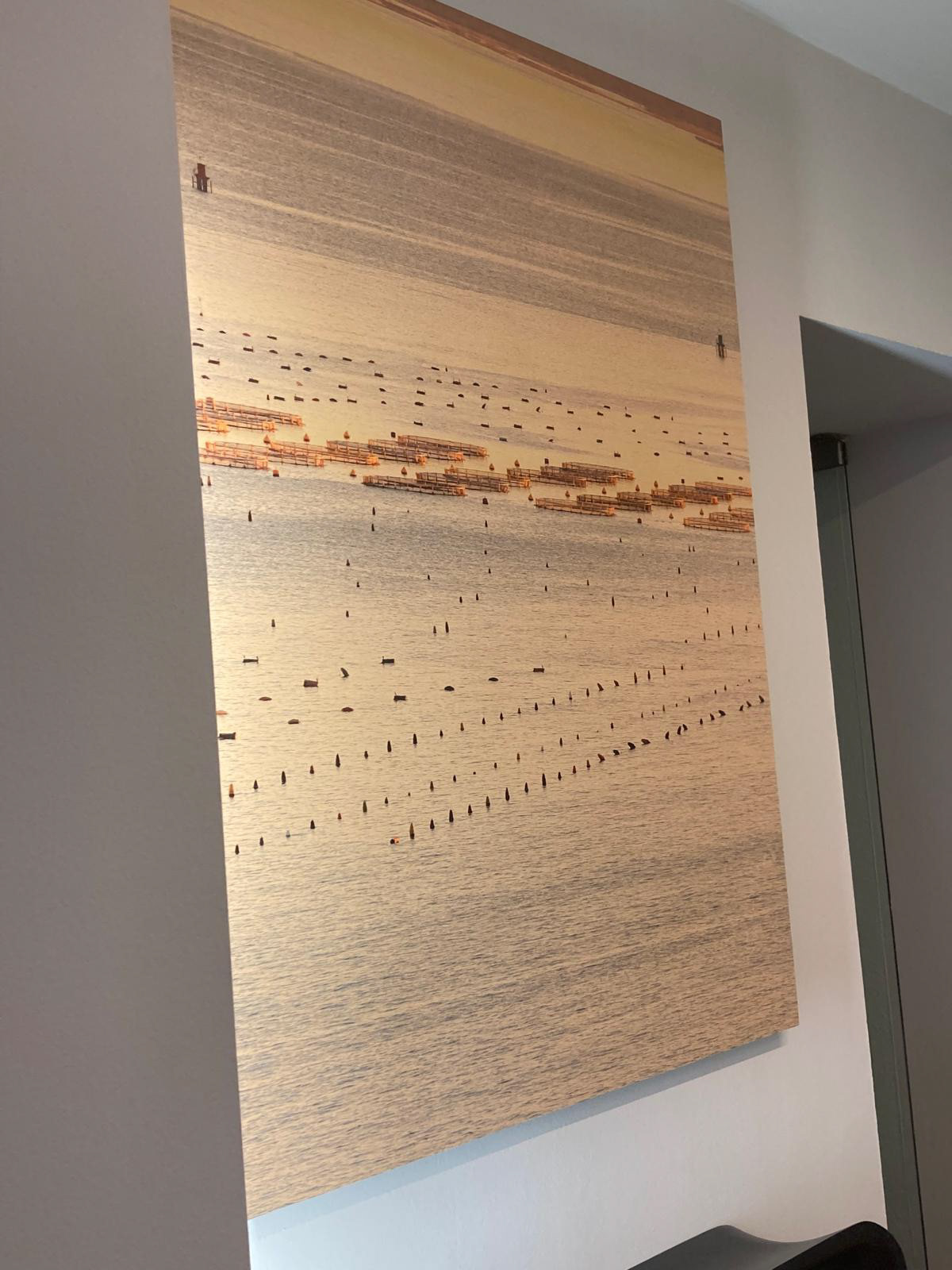
Grazie alle luci che illuminano gli scenari marini, le immagini cercano di stare sul crinale che oggi separa, in forme sempre più labili e imprecise, la fotografia dalla pittura proponendo l’occasione per una riflessione su noi stessi. La mostra si colloca quindi nello spazio indefinito là dove la pittura ha smesso di essere pittura ma dove la fotografia non ha ancora iniziato ad essere fotografia.
Con queste esposizioni si vuole offrire l’opportunità per una rilettura del diaframma tra il bordo del mare e l’infinito, diaframma costruito sul rapporto tra natura e intervento umano. Le immagini, superando lo stesso concetto di unità di spazio-tempo tipico della fotografia, assumono un carattere universale che oltrepassa la stessa riflessione, comunque inevitabile, sul rapporto tra modernità e sfruttamento delle risorse marine. Da un lato, gli elementi naturali acquisiscono quasi l’aspetto di scenari postatomici in cui si rileggono sia l’antico quieto andamento delle onde, sia le fratture imposte dalla contemporaneità, dall’altro, in una atmosfera poetica resa surreale dalle cromie ai limiti del verosimile, i soggetti fotografati sono ridotti all’essenziale dall’uso di un linguaggio proprio della metafisica, intimista e contemplativo, che li immerge in una irreale profondità spaziale allo stesso tempo formale e concettuale.
Il tema non è affrontato sulla base di ciò che oggi l’occhio umano ha o non ha intenzione di vedere osservando, più o meno intenzionalmente, lo scenario naturale, quanto invece, ribaltando il punto di osservazione, di quale sia il punto di vista dell’oggetto indagato, oggetto che solo apparentemente non ha occhi per vedere e orecchie per sentire. La trasformazione quindi dell’uomo da osservatore in osservato, da giudice in soggetto giudicato, ci aiuta a riflettere su noi stessi posti di fronte al mondo ma privati della arrogante sovranità del nostro sguardo che predetermina la composizione di ogni panorama possibile.
Per molte migliaia di anni l’essere umano ha avuto l’opportunità di osservare poche immagini nel corso della propria vita. Solo molto recentemente le immagini viste e fatte proprie nel corso dell’esistenza dell’individuo sono cresciute esponenzialmente fino a creare fenomeni di stanchezza se non di vero e proprio rifiuto. Superata la fase dominata dalla riproduzione di massa di esemplari identici si è passati oggi alla quotidiana auto produzione di decine di singole immagini destinate agli scopi più diversi. Schiacciati sotto una montagna di “scatti fotografici” tali processi si sono tradotti in un diffuso sentimento di arroganza visiva sviluppando un generalizzato approccio di acquisizione acritica del soggetto fotografato.
Quello che qui si propone è uno scarto deciso da questo inquietante scenario mediante l’osservazione pacata e lenta di fotografie in cui l’osservatore accetti di mettersi in gioco e lasciarsi osservare, e quindi anche valutare, dall’oggetto ritratto fino a cogliere l’occasione per una riflessione non episodica su di sé. Una riflessione generata dall’opportunità di trovarsi di fronte a immagini che non impongono punti di vista predeterminati ma che anzi sono disponibili agli ascolti più diversi.
“È quello che c'è da vedere nell'invisibile, che bisogna sforzarsi di vedere. Non costa nessuna fatica vedere quello che è già esposto alla luce del sole. Se ci limitiamo a vedere quello che c'è già da vedere, tuttavia, non abbiamo ancora cominciato a vedere il mondo. Gli occhi, come è noto, sono presuntuosi e pretendono di dettare al mondo come dev'essere visto. Lo sguardo, cioè pensa di essere uno sguardo sovrano. Ma finché si vede solo quello che gli occhi credono di vedere, o - il che è lo stesso - di non vedere, non si è appunto neanche cominciato a vedere quello che il mondo offre alla vista. (Felice Cimatti, L'occhio selvaggio. Sul lasciarsi vedere).
ENGLISH TEXT:
“Photography is subversive not when it shocks, disturbs, or merely stigmatizes, but when it is thoughtful.” (Roland Barthes)
All This Sea That Watches Us
Through the use of artificial lighting that illuminates marine settings, these images attempt to position themselves along the threshold that today separates—through increasingly tenuous and indeterminate forms—photography from painting, while offering an occasion for reflection upon ourselves. The exhibition thus situates itself within an undefined space: where painting has ceased to be painting, yet photography has not fully begun to be photography.
These works seek to provide an opportunity for a re-reading of the diaphragm between the shoreline and infinity—a diaphragm constructed upon the relationship between nature and human intervention. By transcending the very notion of spatio-temporal unity that is characteristic of photography, the images assume a universal dimension that surpasses even the unavoidable reflection on the relationship between modernity and the exploitation of marine resources. On the one hand, natural elements acquire the appearance of almost post-atomic landscapes, within which both the ancient, tranquil rhythm of the waves and the fractures imposed by contemporaneity can be discerned. On the other hand, within a poetic atmosphere rendered surreal by chromatic ranges at the limits of plausibility, the photographed subjects are reduced to their essence through a language rooted in metaphysics—intimate and contemplative—which immerses them in an unreal spatial depth that is simultaneously formal and conceptual.
The theme is not addressed on the basis of what the human eye chooses—or refuses—to see when observing, whether deliberately or not, the natural scene. Rather, by reversing the point of observation, the inquiry turns to the standpoint of the object under investigation—an object that only apparently lacks eyes to see or ears to hear. The transformation of the human being from observer into observed, from judge into the subject of judgment, enables a reflection upon ourselves as we stand before the world, stripped of the arrogant sovereignty of a gaze that presumes to predetermine the composition of every possible landscape.
For many thousands of years, human beings had the opportunity to encounter only a limited number of images throughout their lives. Only very recently has the number of images seen and assimilated over the course of an individual’s existence grown exponentially, giving rise to phenomena of fatigue, if not outright rejection. Having moved beyond the phase dominated by the mass reproduction of identical exemplars, we have now entered an era of daily self-production of dozens of singular images, destined for the most diverse purposes. Crushed beneath a mountain of “photographic shots,” such processes have translated into a widespread sentiment of visual arrogance, fostering a generalized, uncritical mode of appropriation of the photographed subject.
What is proposed here is a decisive deviation from this disquieting scenario, achieved through the calm and sustained observation of photographs in which the viewer accepts to become implicated—to allow themselves to be observed, and thus also evaluated, by the depicted object—thereby seizing the opportunity for a sustained, non-episodic reflection upon the self. This reflection arises from encountering images that do not impose predetermined viewpoints, but instead remain open to a plurality of modes of attention.
“It is what there is to see in the invisible that one must strive to see. It requires no effort to see what is already exposed in the light of day. If we limit ourselves to seeing what is already there to be seen, however, we have not yet begun to see the world. Eyes, as is well known, are presumptuous and presume to dictate to the world how it must be seen. The gaze, that is, believes itself to be sovereign. But so long as one sees only what the eyes believe they see—or, which amounts to the same, do not see—one has not even begun to see what the world offers to vision.”
(Felice Cimatti, L’occhio selvaggio. Sul lasciarsi vedere)
(Felice Cimatti, L’occhio selvaggio. Sul lasciarsi vedere)